AFLAI webinar highlights Kenya and South Africa’s pathways to nationally owned reading benchmarks in multilingual contexts
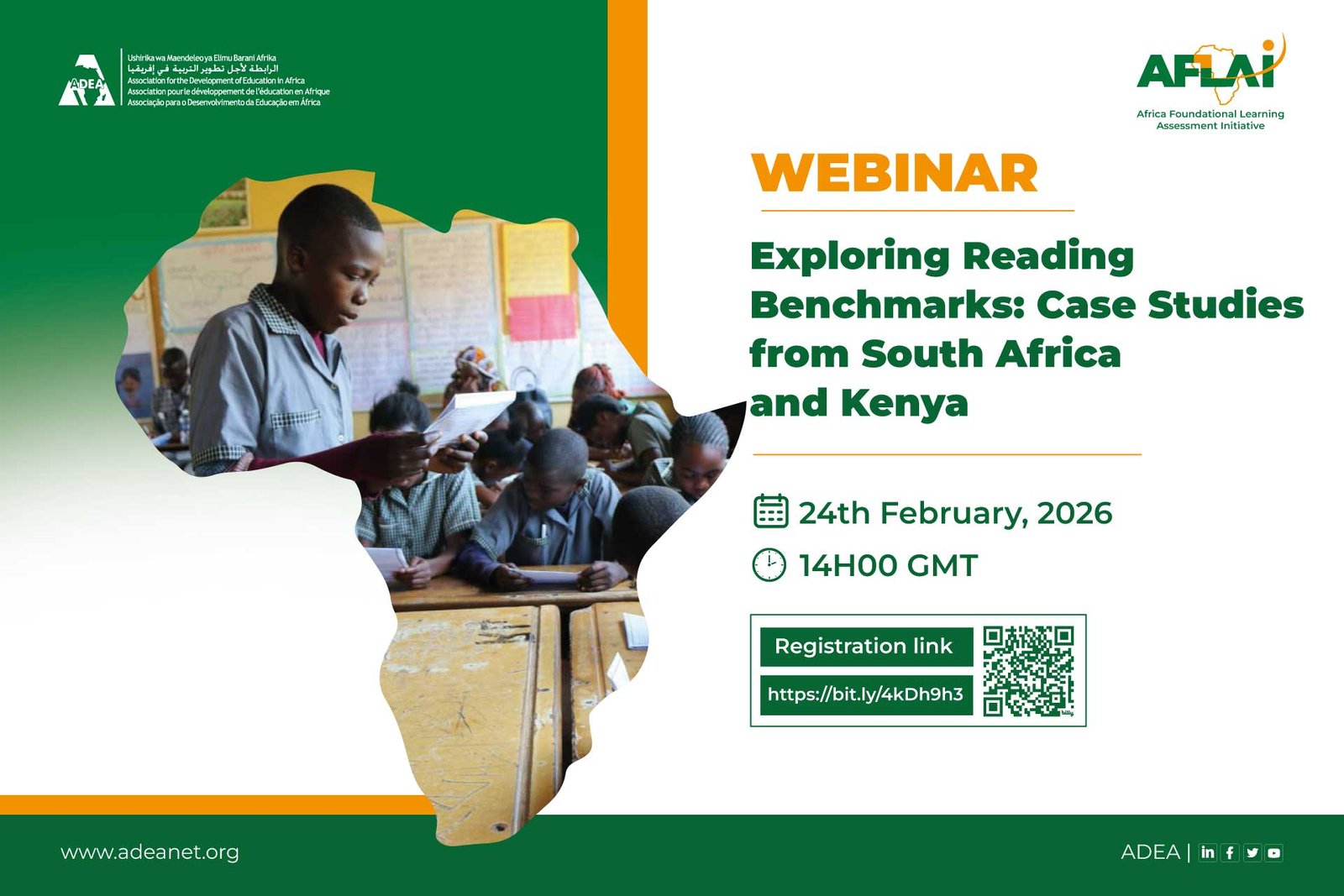
Abidjan, February 24, 2026 – The Association for the Development of Education in Africa (ADEA) successfully convened a webinar under the Africa Foundational Learning Assessment Initiative (AFLAI) to explore the critical role of reading benchmarks in improving literacy across the continent. The event brought together education experts, policymakers, and technical staff to share practical lessons on establishing nationally owned, data-grounded benchmarks. The session which was moderated by ADEA’s Senior Foundational Learning Expert, Dr. Jacqueline Jere Folotiya, featured presentations from South Africa’s Department of Basic Education, Kenya’s National Examinations Council, andan expert from the UNESCO Institute for Statistics (UIS).
In his remarks to set the scene, the Executive Secretary of ADEA, Albert Nsengiyumva, introduced AFLAI and underscored the essence of the initiative to the continent. He described AFLAI’s mission as “straightforward but ambitious”: to support Ministries of Education, examination councils, and their partners in improving the quality, usability, and comparability of foundational learning assessment data. He emphasised that AFLAI does not promote a single assessment tool, but will support countries in strengthening the assessments they already use. He outlined AFLAI’s three components: the Knowledge Exchange Series, a platform for dialogue and peer learning among assessment decision-makers; the AFLAI Microsite, a curated hub of practical resources — including AI applications — expected to go live at the FLEX convening in Lilongwe (15–17 July 2026); and a Technical Assistance facility for countries at all stages of their assessment journey. Professor Cally Ardington (University of Cape Town) framed the broader case for benchmarks: without them, systems can describe performance but cannot answer the fundamental policy question — are children on track?
Country and global perspectives
Kenya’s Epha Ngota (KNEC) described a consultative, country-specific process driven by a single goal: ensuring learners can read independently by Grade 3. Benchmarks evolved from programme-specific tools developed under the Primary Math and Reading Initiative (PRIMR) to nationally representative standards using TUSOME data, resulting in a four-tier framework — zero, beginning, emergent, and fluent readers — now embedded in national assessment and curriculum processes. She highlighted the difficult balance of setting benchmarks ambitious enough to be meaningful yet realistic enough to be achieved. She, however, flagged an ongoing challenge of ensuring classroom textbooks and materials are aligned to the benchmarks.
Dr. Mpumelelo Mohohlwane from the Department of Basic Education (DBE) South Africa presented a landmark undertaking: benchmarks developed for all 11 official languages across Grades 1 to 3, with technical, summary, and policy-brief reports produced for each. National ownership was non-negotiable — regardless of donor involvement, these were DBE benchmarks. They are now institutionalised through the Funda Uphumelele National Study (FUNS), embedded in Annual Teaching Plans, reflected in publisher guidelines for foundation phase reading materials, and feeding an update of EGRA toolkits targeting all foundation phase teachers by 2027. The process also required building capacity from scratch: a team of 25 linguists across 12 universities now supports the work. Research associated with the benchmarking effort found that meaningful comprehension requires both fluency and broader language skills such as morphological awareness — skills that develop on separate developmental paths.
Luis Crouch, a former RTI International executive and UNESCO UIS Board Chair, offered a global validation of these country-led approaches. The UIS psychometric modelling across approximately 50 languages and multiple scripts found comprehension thresholds that closely align with benchmarks set through consultative national processes. For Nguni languages in South Africa, the model suggested 42 words per minute to reach 80% comprehension and 27 words for 60% — closely straddling the nationally set benchmark of 35 words. Crouch recommended protocolising the benchmark-setting process based on documented country experiences, extending work to underresearched language groups, and building comparable continental frameworks.
Key takeaways
The key themes below were outcomes from the session.
- National ownership is non-negotiable: benchmarks must belong to governments, not funders.
- Data must be locally grounded and grade-appropriate.
- Multi-stakeholder engagement — across technical experts, teachers, policymakers, and partners — is essential.
- Benchmarks must be institutionalised in monitoring systems, curricula, and teacher tools.
- System transitions offer valuable windows for review and strengthening.
- Deep linguistic analysis is required: benchmarks cannot be translations or adaptations from English.
Looking ahead
AFLAI’s Knowledge Exchange Series will continue with upcoming blogs and webinars on AI and assessment, FLN assessment planning, data use, and language considerations in assessment. The AFLAI Microsite is expected to launch at FLEX in Lilongwe in July 2026.
About AFLAI: The Africa Foundational Learning Assessment Initiative is an African initiative led by ADEA, in collaboration with partner organisations, to strengthen literacy and numeracy assessments across the continent.