Malawi – ADEA ESDC Project: Mapping of Initiatives and Assessment of Capacity Needs
1. Introduction and Background
The Association for the Development of Education in Africa (ADEA), as a critical voice of education in Africa, seeks to empower African countries to develop responsive educational systems for sustainable development. Its vision is to create “a high-quality education and training system for accelerated sustainable development of Africa.” ADEA’s mission, therefore, is “to serve as an open and flexible pan-African organisation that informs and facilitates the transformation of education and training systems for resilience, human capital development, and youth empowerment in Africa”. ADEA has played a significant role in the education space for over 34 years as a convener, catalyst, knowledge creator, and forum for policy dialogue. ADEA’s overall goal is “to empower African countries to transform schooling to meaningful learning by leveraging our globally connected partnerships, a well-equipped and skilled Secretariat, and country-led Inter-Country Quality Nodes (ICQNs)”. ADEA achieves this goal through its continental and regional level work and country-focused support using the thematic-based ICQNs as a community of practice for peer learning, knowledge exchange, and experience sharing.
Africa faces a data crisis in education and skills. Since the Education For All (EFA) 2000 and transcending subsequent major global and continental frameworks (MDGs, SDG4, AU Second Decade of Education for Africa 2006-2015, Continental Education Strategy for Africa 2016-2025), the availability of quality education and skills data for informed decision making has been a perennial challenge in many African countries. This is in terms of evidence-based research, policy, planning, implementation, monitoring, and evaluation of impact. The COVID-19 pandemic exacerbated the situation, especially for the education sector. In many African countries, the education sector did not contribute significant comprehensive data to inform change in policy and practice responses regarding continued remote education and reopening of learning institutions.
Due to the above-identified challenges, ADEA is partnering with the Mastercard Foundation Centre for Innovative Teaching and Learning (CITL) in a five-year “Tackling Education and Skills Data Challenge (ESDC)” initiative to strengthen the capacity of up to 30 African countries “to produce, report and utilize quality data on education and skills for informed decision making in policy, planning, programme implementation, monitoring, and evaluation of impact.”
This initiative is expected to achieve the following objectives:
- Create an appetite for leadership to demand quality education and skills data. This will result in a shift in the decision-making approach to be more evidence-based.
- Strengthen the capacity of the Ministries of Education in the selected African countries to use quality data to reform their education sectors to provide quality education and skills to the youth.
- Provide a platform for peer learning, knowledge exchange and experience sharing among African countries on the production, management, and use of data on education and skills.
- Build regional peer learning for greater coordination and planning in education at regional level.
- Develop a roadmap for scaling up the 30-country experience to other African countries.
Data and data-driven tools are becoming crucial for effective governance, especially in the education sector. They play an essential role throughout the public policy process, from identifying needs to implementing and evaluating policies. By offering a strong foundation for informed decision-making, these tools ensure that the policies created effectively address the challenges at hand. Their significance can be emphasized at multiple levels.
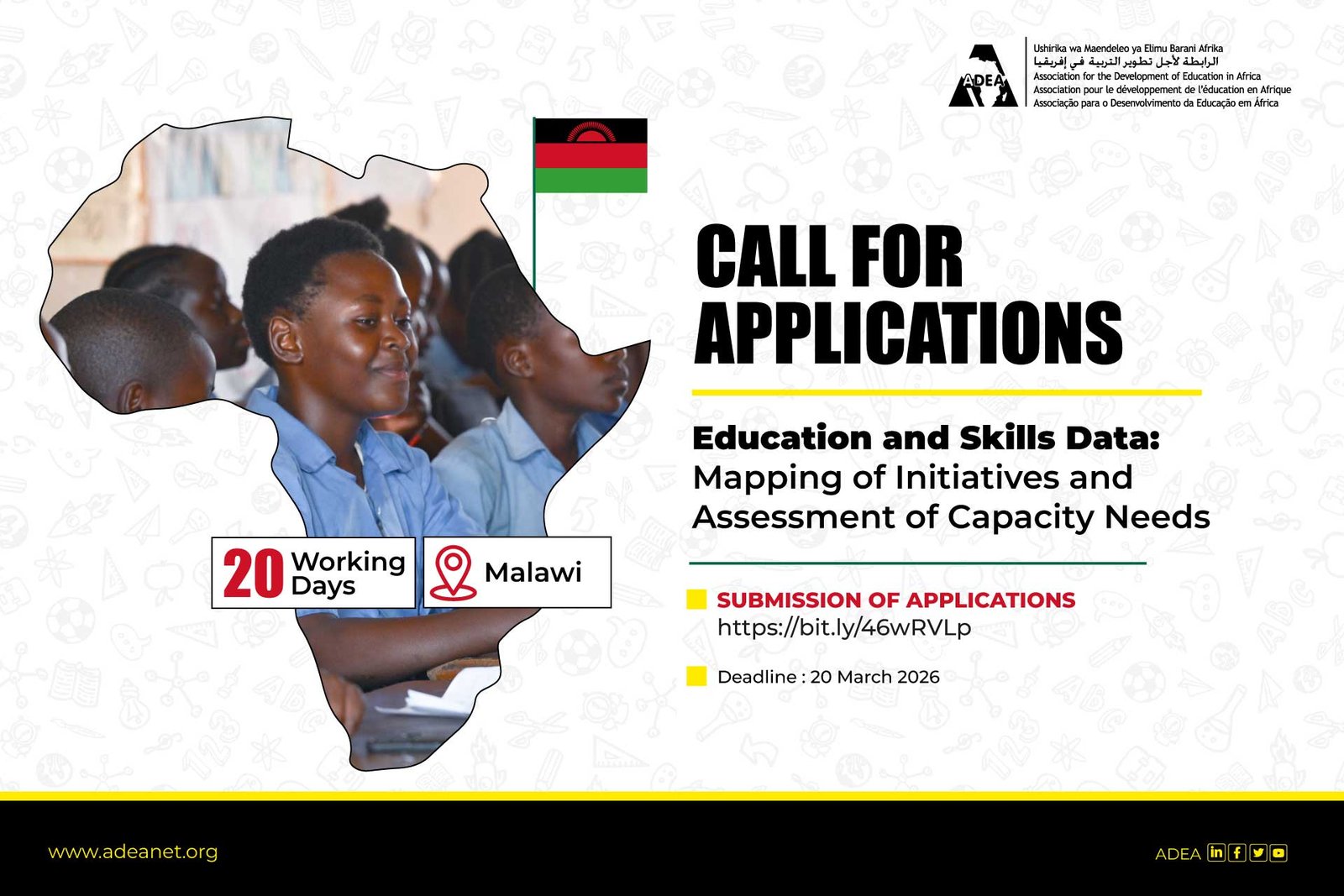
Through the ESDC Initiative, ADEA is engaging an Malawians national in-country resource person to assist in a comprehensive assessment of Malawi’s education and skills data landscape.
2. Rationale for Mapping Study and Needs Assessment
The goal of the assignment is to deepen understanding of data production and utilisation in Malawi, identify needs and priorities to improve the quality of education and skills data, and promote data-driven decision-making. To achieve this, it is essential to comprehensively assess current data production processes, identify gaps in capacity, and map data-related initiatives. Also, an assessment of the Ministry of Education’s capacity to leverage technology for education and skills data is essential. The outcomes of this mapping study and needs assessment will inform the joint development of a costed action plan for strengthening the capacity of relevant government stakeholders.
3. Scope of Work
The Malawians national and in-country resource person will perform the following tasks for Malawi:
- Map education and skills data–related initiatives (ongoing or have been implemented) covering foundational learning (early childhood, pre-primary, and primary); secondary; TVET; and higher education levels in the last five years, in order to identify lessons learned, challenges, and potential synergies with the ESDC initiative. For each initiative, the consultant will document the following:
- What are the objectives, scope, and achievements of the initiative?
- What is the implementation approach, and who has been involved?
- What are the success factors or bottlenecks?
- What lessons have been learned?
- What are the potential areas of synergy with the ESDC Initiative?
- Assess the availability of data to report on national education monitoring and evaluation framework.
- Assess the data available for a selected number of CESA 16-15 and/or CESA 26-35/SDG 4 indicators to be monitored at continental and global levels.
For each indicator, the consultant must answer the following questions:- Is data available to report on the selected indicator, and within which institution?
- How frequently is this indicator reported?
- Are there any gaps or challenges in reporting this indicator?
- If data is not available, what are the root causes?
- Assess the country’s capacity to produce, process, report, and use data to inform EdTech and inclusive education, including gender, policies
- Assess, per sub-sector (Basic education including foundational learning, secondary education, TVET, Higher Education) the production and utilization of education and skills data through the Education Management Information System life cycle using the Regional EAC EMIS Norms and Standards Assessment Framework published by AUC and ADEA
- Identify key institutions (producers and users) such as government (Ministries, agencies, and learning institutions), NGOs, country, regional and international partners, and private companies involved in education data collection, analysis, and skills development.
- Analyze current processes and methodologies and identify gaps or overlaps in education and skills data practices.
- Establish a comprehensive baseline to better understand the current state of education and skills data production and usage, identifying strengths, weaknesses, opportunities and areas for improvement.
- Identify good practices, including the use of digital technology to manage and improve quality education and skills data production, management, and utilization; as well as collaborations with development partners and/or private sector organizations.
- Assess country capacity needs and priorities in education and skills data production and use:
- Evaluate the existing skills, tools, and resources of data producers and users, and assess their current data management practices and technological infrastructure.
- Assess capacity gaps for data harmonisation and system integration processes within and between Ministries responsible for education and skills development, and integration of technology, including the use of Artificial Intelligence for data management as a whole and data analysis in particular.
- Identify areas of improvement in based on the capacity gaps identified above.
- Identify a set of priority needs for capacity strengthening based on the above.
- Prepare a final report that includes data-related initiatives mapping, findings and recommendations of the assessment and country priorities.
- Facilitate the validation process of the report with the Ministry of Education and other relevant ministries and stakeholders.
The resource person is expected to maintain effective and professional collaboration with the project focal points and ADEA throughout the assignment.
4. Methodology
The mission is mainly qualitative, and the resource person will carry out the assignment in accordance with ADEA’s standard policies and procedures, comply with evaluation norms, and follow ethical safeguards. All efforts must be made to ensure that the process is participatory to ensure the involvement of the country’s key stakeholders, especially the Ministry of Education and other related Ministries and government institutions, partners, academia, and private sector players.
The resource person will use the agreed methodology and tools (e.g., the AUC-ADEA Regional EMIS Norms and Standards Assessment Framework for EAC/IGAD), with the following as a minimum, for the assignment:
- Desk review:
A review and analysis of relevant documents and reports of country educational system, education and skills policies, implemented data-related initiatives implemented by the Ministry(ies), partner profiles and their supporting initiatives, among others.
- Partner consultations:
The resource persons will conduct in-person group/individual discussions with the key education and skills data stakeholders (producers and users), including the Ministry of Education's key directorates, key directorates of other relevant ministries such as the Ministry of Technology, the National Institute of Statistics, as well as representatives from one district or regional office of the Ministry of Education. Discussions will also involve a primary school, secondary school, TVET centre, and higher education institution, along with relevant development partners, civil society organisations (CSOs), and ESDC project country focal points.
5. Expected Deliverables
The consultant will be required to provide the following deliverables, submitted to the ESDC Project Manager:
- An inception report within 3 days of signing the contract, which includes the methodology and the timeline of the assignment.
- A draft Needs Assessment Report for review and feedback, which includes the data-related initiatives mapping, findings and recommendations of the assessment and country priorities.
- A Validation Report approved by the Ministry of Education.
- A final Needs Assessment Report submitted to, and approved by, ADEA Secretariat.
6. Profile of Resource Persons
- The candidate must be a national and in-country resident of the country of assignment
- Proven ability and experience in conducting mapping studies and needs assessment.
- Extensive experience in education and skills data management, including data production, utilization, and harmonization.
- Strong knowledge of selected country educational system.
- Proven ability to engage with diverse stakeholders and navigate complex political environments.
- Strong analytical and communication skills to assess, interpret, and present complex data and concepts effectively.
- A minimum of master’s degree in education, economics, statistics, development studies, project management or related discipline and strong experience conducting qualitative and quantitative evaluations as well as development of strategic documents.
- Proficiency in spoken and written English. A working knowledge of French would be an asset.
7. Duration and Schedule
The assignment will take place over a period of 20 working days, with a breakdown of time allocation as follows:
- Pre-mission preparation (4 working days): Review of background documentation, development of methodological approach and tools
- Consultations (10 working days): Consultations with key education and skills data stakeholders
- Reporting and presentation (6 working days): Preparation of report and debriefing with ESDC Project Manager and Ministerial staff (including report validation).
8. Supervision and Reporting
The Resource Persons will work under the direct supervision of the ESDC Manager. Regular updates will be provided to the Manager, and the Resource Person will submit all deliverables in accordance with the agreed timeline.
9. Submission of applications
Applicants should submit the following:
- A copy of the CV and an expression of interest, including a motivation letter explaining how they understand the mission and relevant experience.
- A technical proposal.
- Financial offer. The financial offer should include:
- the daily fees in USD, and
- detailed breakdown of tasks for the number of days for this assignment.
Applications must be sent online through this link no later than Friday, 20 March 2026.
For any clarification or additional information, please contact: adea@afdb.org
Due to the high volume of applications, only selected candidates will be contacted through a formal email correspondence. Do not contact ADEA or its staff members about the status of your application.