ADEA ESDC Project in Nigeria: In-Country Institutions to Support Capacity-Strengthening Interventions
1. Context and justification
ADEA Overview
The Association for the Development of Education in Africa (ADEA) is a critical voice of education in Africa that seeks to empower African countries to transform schooling to meaningful learning. ADEA achieves its goal through its continental-level work and country-focused support using the thematic-based Inter-Country Quality Nodes (ICQNs) – communities of practice for peer learning, knowledge exchange, and experience sharing. Its vision is to create “a high-quality education and training system for accelerated sustainable development of Africa.” ADEA’s mission therefore is to “serve as an open and flexible pan-African organization that informs and facilitates the transformation of education and training systems for resilience, human capital development, and youth empowerment in Africa.”
Tackling Education and Skills Data Challenge (ESDC) Initiative Overview
Africa faces a data crisis in education and skills. Since the Education For All (EFA) 2000 and transcending subsequent major global and continental frameworks (MDGs, SDG4, AU Second Decade of Education for Africa 2006-2015, Continental Education Strategy for Africa 2016-2025), the availability of quality education and skills data for informed decision making has been a perennial challenge in many African countries. This is in terms of evidence-based research, policy, planning, implementation, monitoring, and evaluation of impact. The COVID-19 pandemic exacerbated the situation, especially for the education sector. In many African countries, the education sector did not contribute significant comprehensive data to inform change in policy and practice responses regarding continued remote education and reopening of learning institutions.
Due to the above-identified challenges, ADEA is partnering with the Mastercard Foundation Centre for Innovative Teaching and Learning (CITL) on a five-year initiative, “Tackling Education and Skills Data Challenge (ESDC)”, to strengthen the capacity of up to 30 African countries to produce, report and utilize quality data on education and skills for informed decision making in policy, planning, programme implementation, monitoring, and evaluation of impact.
This initiative is expected to achieve the following objectives:
- Create an appetite for leadership to demand quality education and skills data. This will result in a shift in the decision-making approach to be more evidence-based.
- Strengthen the capacity of the Ministries of Education in the selected African countries to use quality data to reform their education sectors to provide quality education and skills to the youth.
- Provide a platform for peer learning, knowledge exchange and experience sharing among African countries on the production, management, and use of data on education and skills.
- Build regional peer learning for greater coordination and planning in education at regional level.
- Develop a roadmap for scaling up the 30-country experience to other African countries.
As part of the ESDC initiative’s ongoing efforts to strengthen national capacities on quality education and skills data production and utilization, comprehensive country needs assessments have been undertaken, priority areas identified, and action plans developed. ADEA engages in-country institutions to support the implementation of the action plans.
ADEA therefore seeks a dynamic and experienced in-country institution to support the Federal Ministry of Education in Nigeria (FME Nigeria) in the implementation of impactful capacity-strengthening interventions, based on agreed action plan, for sustainable growth in education and skills data production and use in the country.
2. Purpose of the Assignment
The selected in-country institution will support FME Nigeria in implementing the agreed action plan to meet the following objectives:
- To improve quality of education and skills data
- To strengthen knowledge and skills on data protection and security
- To build the analytical capacity of ministry and agency personnel to enhance evidence-based planning, monitoring, and policy formulation.
This will entail, among others, coordinating the delivery of capacity-strengthening interventions and ensuring the timely achievement of agreed deliverables, in full alignment with the expectations and strategic priorities of ADEA and the Ministry.
3. Scope of work
The in-country institution, under the leadership and guidance of FME Nigeria, will be responsible for implementing the following activities:
A. Priority area: Data validation, confidentiality, and analytics
i. Develop data validation training manual
As part of its overall Data Quality Assurance (DQA) strategy, the Federal Ministry of Education (FME), Nigeria, intends to develop a comprehensive Data Validation Manual, covering the entire data production chain—from school level to national level—together with an accompanying training manual.
The in-country institution will co-develop both documents in close collaboration with the FME. Specifically, the in-country institution will be responsible for the following tasks:
- Review current data validation processes across all levels of the education data production lifecycle.
- Map and document key stakeholders involved at school, sub-national, and national levels, including their respective roles and responsibilities.
- Develop a standardized Data Validation Manual aligned with national data governance and quality standards.
- Develop a training manual translating the validation procedures into practical, user-oriented training modules.
- Support and facilitate the technical and institutional validation of both documents by the FME and ADEA, incorporating feedback and ensuring alignment with regional and international best practices.
- Design and conduct a Training of Trainers (ToT) at the federal level, targeting key 120 technical staff to enable effective cascading of data validation practices to sub-national levels.
Deliverables:
- Data validation manual
- Data validation training manual
- Data Validation Process Assessment report
- Training report
ii. Training on Record Keeping for Head-Teachers
Data entry is a key component of quality data production. The Federal Ministry of Education (FME) Nigeria leverages multiple technologies for data entry at the school level. However, head teachers currently face challenges in effectively using these technologies.
To address these challenges, the in-country institution will develop tailored training modules and conduct Training of Trainers (ToT), followed by sample-based training for 1,200 participants across two states.
Specifically, the in-country institution will develop and deliver a training module covering the following areas:
- Data entry in DHIS2 using laptops, tablets, and Android devices.
- Common data quality issues and their implications for planning and decision-making.
- Data verification and validation procedures.
- Basic capacity to analyze, interpret, and use key education indicators for school and system-level improvement.
Deliverables:
- Training modules/materials
- Training report
iii. Training on data confidentiality and security
To strengthen participants’ capacity to protect education and skills data throughout the data lifecycle, in compliance with national regulations and best practice, the in-country institution will develop a context-based module to strengthen the capacity of 30 ministry staff in charge of data across basic education, secondary education, TVET and higher education sub-directorates, and EMIS department. The module will cover:
- Principles of data confidentiality, privacy, and security
- National data protection regulations and institutional data governance responsibilities
- Identification and handling of sensitive and personally identifiable education data
- Secure data collection, storage, access control, and data sharing practices
- Ethical data use, anonymization, and secure reporting
- Data security risks, prevention measures, and incident response procedures
Deliverables:
- Training modules/materials
- Training report
iv. Training on analytical skills
Strengthening the capacity of central-level ministry staff in data analysis represents a strategic investment in advancing evidence-based decision-making and enhancing the effective use of data for policy formulation and planning. This activity aims to build competencies in data processing, analysis, and reporting through the use of dedicated applications and software, with a strong emphasis on reproducibility, efficiency, and the automation of routine analytical tasks.
The in-country institution will design and deliver context-specific training modules to strengthen staff capacities in the following areas:
- Training of 30 ministry staff on education and skills data collection, processing, analysis, and interpretation for SDG 4, CESA, and national indicator reporting, using SPSS, including the development of policy briefs.
- Training of 30 ministry staff on education and skills data engineering and machine learning techniques, with practical applications relevant to sector data using python.
- Training of 30 ministry staff on DHIS2, focusing on API integration and dashboard development for data visualization and reporting.
Each training module shall integrate best practices in automation, reproducible research, and quality assurance throughout the analytical workflow.
At the sub-national level, the in-country institution will develop a tailored module and conduct a Training of Trainers (ToT) for 60 participants on the fundamentals of data processing and analysis using Excel, targeting State Ministries of Education and Local Government Authority (LGA) officers.
Deliverables:
- Training modules
- Training report
- Evaluation report
B. Financial and logistic assignments:
Finance functions:
- Manage project budgets and track expenditures.
- Ensure financial transactions follow agreed standards and donor requirements.
- Prepare and share financial reports regularly for review.
Logistics functions:
- Manage procurement of goods and services required for implementation.
- Coordinate travel, meetings, and other operational requirements.
Deliverables:
- Quarterly financial report.
C. Communication and Advocacy
Communications on the project at the country level and advocacy on important thematic issues are essential to its success.
The in-country institution will undertake the following communications functions:
- Co-create with FME Nigeria and ADEA the development of a communication strategy, and publicity and training materials (content for infographics, etc.)
- Support to the project’s communications officer and relevant Ministry official with the creation of content for knowledge management for the duration of the project at the country level with country insights (blog pieces, dispatches, policy papers, articles, Op-ed, etc.)
- Provide support on country insights to the project’s communications officer on best approaches to operationalize the country communications strategy
- Support with media engagement and monitoring throughout the duration of the project in the country
- Support with the preparation and drafting of communications report covering the project implementation period in the country.
Deliverables:
- Communications strategy
- Monthly communications report
- Media monitoring report
4. Timeline
The implementation of the country action plan is estimated to be completed within a maximum of 12 months.
5. Qualification and Experience
i. Institutional Qualifications
- Legally registered in Nigeria or within the Western African region with authorization to operate in Nigeria.
- Minimum of 5 years of proven experience in education and skills data management, capacity strengthening, and training.
- Demonstrated experience working with government ministries and education stakeholders.
- Proven ability to manage development partner-funded projects with transparency and accountability.
- Data management proficiency: Expertise in data collection, analysis, management, and reporting, with a focus on education and skills data.
- Training and facilitation skills: Proven ability to design and deliver high-quality training programs, workshops, and mentorship sessions.
- Coordination: Ability to organize and manage training sessions, workshops, and events, including travel and accommodation for participants.
ii. Operational Capacity
- Financial Management: proven capacity to manage project funds with transparency and accountability.
- Procurement: demonstration of the implementation of standard procurement practices.
- Human Resources: demonstrate the ability to implement standard Human Resources management practices
- Grants Management: ability to run donor funded programs.
- Governance: involvement of management in projects.
- Audits: proof of experience with annual financial audits
- Risk management: provide documented key aspects of the risk management plan
iii. Stakeholder Engagement and Collaboration
- Partnership: Demonstrated established relationships with Ministries of Education and other relevant stakeholders.
- Communication skills: Effective communication and interpersonal skills to engage effectively with stakeholders.
- Result-driven and results-oriented
- Quality assurance: A commitment to deliver high-quality outputs, including training modules, reports, assessments, etc.
- Innovation: Willingness to adopt innovative tools, technologies, or methodologies to enhance the effectiveness of capacity-building activities.
iv. Expertise of Proposed Team
- Project Manager with expertise in education and skills data systems.
- Data Management Specialist with experience in CESA/SDG4 indicators.
- Training & Capacity Building Specialist experienced in developing and delivering training programs.
- ICT/Dashboard Developer proficient in Power BI or similar tools.
- Monitoring and Evaluation Specialist to track project implementation.
6. Application Requirements
Interested institutions should submit the following documents as part of their application:
- Organizational profile: Mandate of the institution, including mission, vision, and key achievements.
- Legal status of the entity.
- Relevant experience: 5 years of proven experience in education and skills data production and analysis and conducting capacity development programmes.
- Team CVs: Detailed CVs of the project implementation unit.
- Proposed methodology: A clear and detailed plan for implementing the capacity-building plan.
- Detailed budget proposal: A realistic budget aligned with the country plan.
- References: Contact information for at least five references from previous assignments.
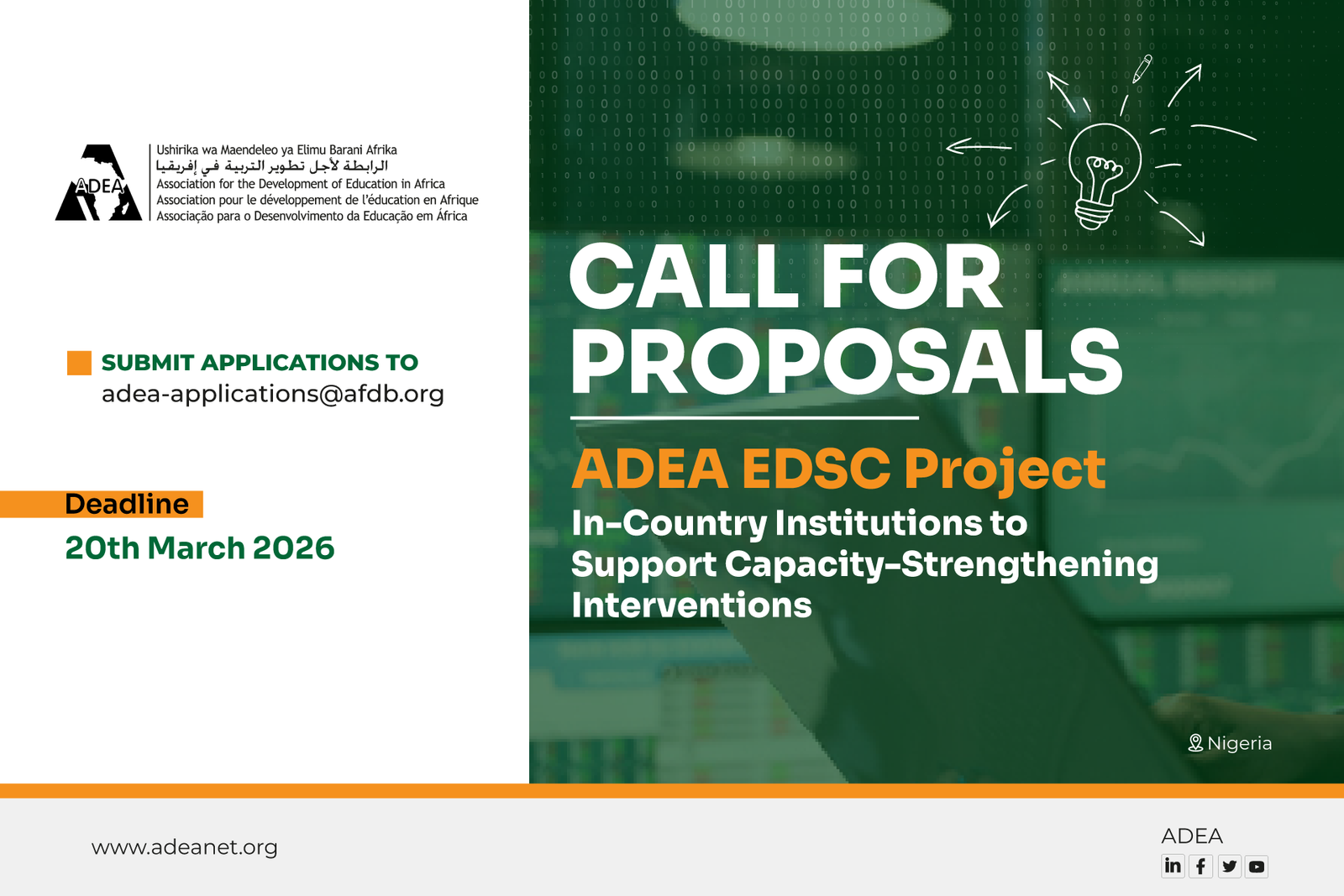
Applications must be sent to adea-applications@afdb.org no later than 20 March 2026 at midnight GMT. The subject of the e-mail should be “ADEA ESDC Project in Nigeria: In-Country Institution”.