How South Africa built its reading benchmarks—a story of evidence, collaboration and adaptation
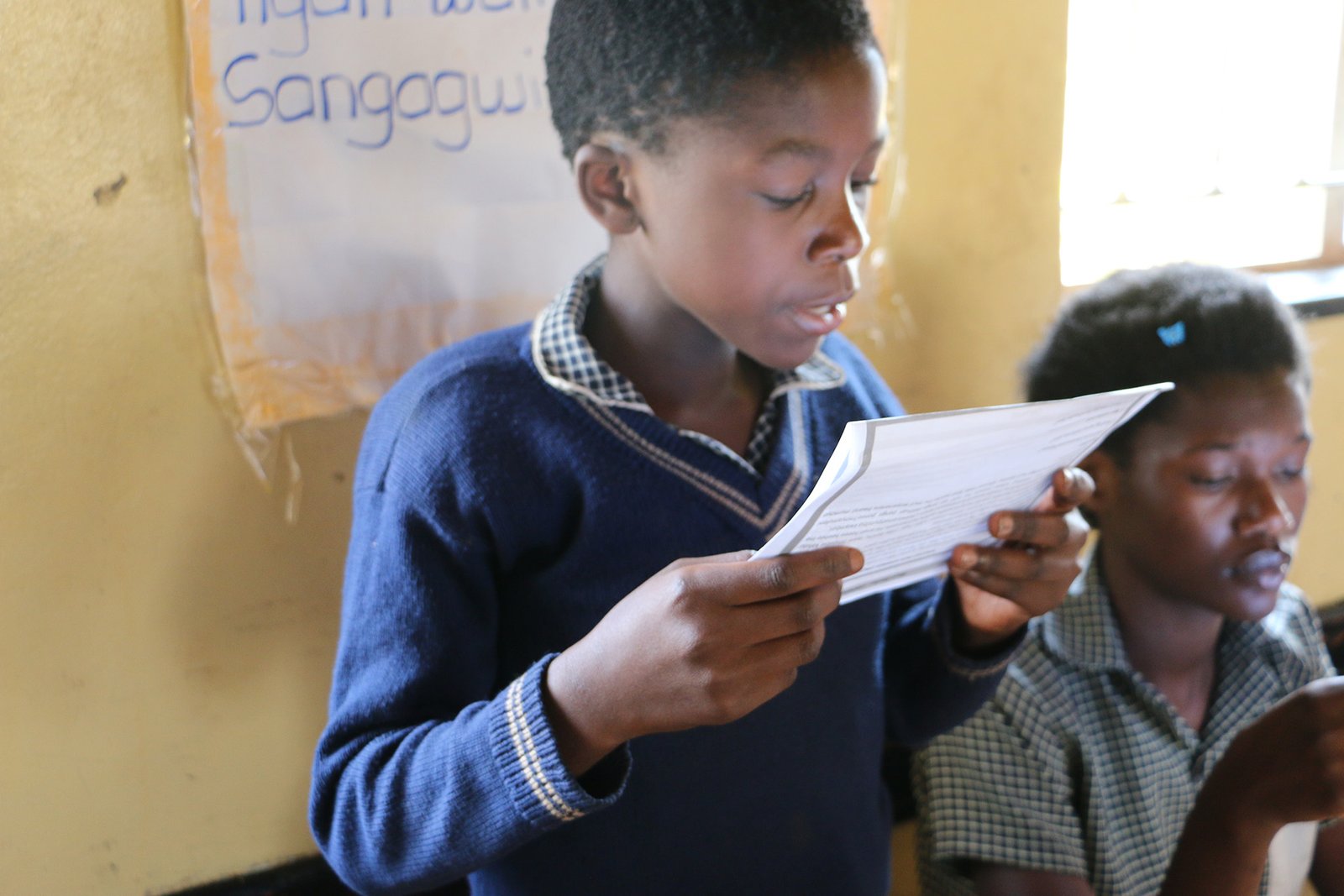
Around the world, simply attending school is no guarantee of learning, and South Africa has faced a significant challenge: too many children reach the later grades without the foundational skill of reading with comprehension. The complexity of South Africa's 11 official languages only compounds this issue, making it difficult for teachers and the system to gauge whether a child is truly on track for reading success.
In 2019, various units within the South Africa’s Department of Basic Education (DBE), joined by researchers, language specialists, and partner institutions, set out to find an answer. They knew, more local work was needed to understand how well school children were reading in the early grades. Available benchmarks were built around English in high-literacy contexts—far removed from the multilingual classrooms of rural Limpopo or the townships of KwaZulu-Natal.
Instead, they turned inward—to a rich archive of existing data, gathered over the years, following many reading interventions that had tested and tracked learner performance across the country. These studies were not originally designed to set benchmarks, but they held an advantage: they reflected real South African classrooms, with all their complexity. By piecing together results from over 35,000 learners across 660+ no-fee-based schools, the team began to construct a picture of how reading develops—one learner, one language, one threshold at a time.
This government-led initiative ultimately established empirically grounded early-grade reading benchmarks for all 11 official languages, with clear, measurable targets for foundational skills in Grades 1 to 3.
The team used the Early Grade Reading Assessment (EGRA) to identify these developmental thresholds. Traditionally, EGRA gives children just one minute to read a passage. However, the South African team recognized that slower readers never reached the comprehension questions at the end. The data was skewed. So, they adopted a change—a small but powerful one—giving learners an extra two minutes to finish reading. This simple shift decoupled the measurement of fluency and comprehension, allowing for a truer understanding of how the two skills interact.
They moved beyond old methods that focused on an arbitrary, fixed comprehension score. Instead, they looked for developmental thresholds: the point where a child is fluent enough for comprehension to begin and the point where further speed no longer increases understanding (meaning instruction should shift to focus on comprehension).
Take isiZulu, for instance. The data showed that learners reading fewer than 20 words per minute were still wrestling with decoding—their brains working too hard to make sense of the sounds to think about meaning. But once they reached 35 words per minute, comprehension gains began to plateau. That was the sweet spot: the benchmark. Similar thresholds were identified for each language.
But fluency was only one part of the puzzle. The team tested whether these benchmarks made sense in the real world:
- Were they aligned with what children are taught in the national curriculum?
- Did they help predict success in later grades?
- Were they achievable yet ambitious?
Using data from Grades 2 to 7, they found a clear pattern: children who met the benchmark early on were far more likely to perform well in later comprehension tasks. Benchmarks weren’t just numbers—they were early indicators of future learning.
The process was careful, iterative, and rooted in humility: the team didn’t impose assumptions from other contexts. They let the data speak—and what it said was powerful.
What changed: results and outcomes
The launch of South Africa’s Funda Uphumelele National Study (FUNS) marked the first time the country could report nationally representative data on early reading benchmarked in all 11 official languages. With these benchmarks in hand, change is extending further [NM2] through the system:
- In classrooms, teachers could now identify which learners were falling behind—not just vaguely, but with precision. A child reading 18 words per minute in grade three in isiXhosa was not "almost "there"; they were below the decoding threshold and needed targeted support.
- District officials began using benchmark-linked indicators to identify struggling schools. Instead of relying solely on grade four comprehension scores—when it was often too late—they could now intervene in grade one or two.
- Teacher training programs incorporated the benchmarks, helping new educators understand the developmental stages of reading and what realistic progress looked like by grade and language.
- Learning materials and monitoring tools are being realigned so that reading books, assessments, and lesson pacing match the developmental realities revealed by the benchmarks.
- And perhaps most significantly, FUNS created a national platform for foundational learning—one that will collect new data every three years, enabling policymakers to monitor trends and course-correct.
Across provinces and language groups, benchmarks are already being used to shift instruction and accountability—not with a stick, but with a compass.
Why It worked: what are the lessons from the South African experience
South Africa’s success in developing early-grade reading benchmarks wasn't just a technical achievement. It was a strategic and institutional breakthrough, built on five core pillars:
- National ownership
This was not an externally driven reform. From start to finish, the benchmarking effort was led by the Department of Basic Education, with deep involvement from provincial teams and national institutions. That ownership created legitimacy — and buy-in. - Collaborative intelligence
The project united a wide array of actors: universities, non-profits and civic organizations, local researchers, curriculum experts, teacher trainers, and statisticians. Each brought their piece of the puzzle. That collaboration didn’t just produce good benchmarks—it built national capacity to continue the work. - Language respect
Rather than forcing uniformity, the team embraced linguistic complexity. They treated each language as deserving of its own data, analysis, and standard, creating a system that is linguistically just and instructionally meaningful. This presents a very strong case for actors pushing for local dialects as the language of instruction. - Data-driven yet grounded
The work was technical—but never disconnected from the classroom. Every statistical threshold was tested for meaning, attainability, and curricular relevance. Benchmarks were not arbitrary: they were informed by real learners in real schools. - Sustained vision
The DBE didn’t treat benchmarking as a one-off study. With FUNS now institutionalized, reading progress will be tracked across time—ensuring that early gains are not lost and that benchmarks continue to shape instruction, training, and policy.
These benchmarks are not the ceiling. They are the floor every child deserves to stand on. They are the step that allows children in South Africa to reach grade four not lost, but ready. Not still learning to read but reading to learn.
South Africa’s story is proof that complex problems don’t always need imported solutions. Sometimes, the answer is already in your own languages, your own data, your own classrooms—if you're willing to measure what matters. It presents significant lessons for countries across Africa with similar context challenges in this area. The evidence we need is right available for us. We just need to understand the information and how to harness it.
Author’s Note:
South Africa’s early-grade reading benchmarks were developed across all official languages through a locally led, data-driven process uniting researchers, educators, and government leaders. The process, methodology, and outcomes of this intervention are fully documented in a technical bulletin drafted by Dr. Nompumelelo Mohohlwane from the Department of Basic Education and Prof. Cally Ardington of AFLEAR at the University of Cape Town.
To learn more about the detailed methodology, data sources, and results, read the full technical bulletin on the ADEA knowledge hub.